
Sourcing Gear for Host Cities World Cup 2026: A Logistics Guide for Local Distributors
Overview
This guide explains how local distributors can plan World Cup 2026 inventory across host cities, balance blank and fanwear programs, manage cross-border delivery risk, and set reorder windows before demand compresses around match dates.
Why host-city planning is not a normal sportswear cycle
The 2026 FIFA World Cup will run across the United States, Canada, and Mexico, with 104 matches scheduled across 16 host cities from June 11 to July 19. For local distributors, that scale changes the sourcing model. Inventory can no longer be planned only by seasonality or by broad national demand.
A World Cup cycle compresses demand around match dates, fan travel patterns, and city-level activation. Travel data already shows flight and hotel bookings spike after the schedule announcement, which is an early signal that local sell-through will not mature at the same pace in every market.
How to allocate inventory by host-city cluster
We usually advise distributors to divide host markets into three groups: core host cities with direct stadium traffic, adjacent cities that benefit from overflow demand, and non-host markets that will still move event-driven fanwear through online and retail channels. This avoids overcommitting the same SKU depth everywhere.
For event-led demand, local inventory should be tied to likely customer behavior rather than only to population size. A city with strong match-day traffic may require faster replenishment and broader size coverage, while a secondary market may perform better with tighter assortments and more conservative reorder triggers.
Which product mix works for local distributors
For most distributors, the safest mix is not a single hero program. We recommend combining national team jersey programs for event demand, blank teamwear for local decoration and quick-turn jobs, and a smaller layer of youth sizes or souvenir-adjacent items where channel feedback supports them.
This mix matters because fan-driven demand and teamwear demand move differently. National-team styles tend to react to fixtures, tournament narratives, and country-specific fan traffic, while blank jerseys support local clubs, watch parties, schools, and promotional buyers that need flexible decoration rather than exact matchwear styling.
What logistics model reduces avoidable margin loss
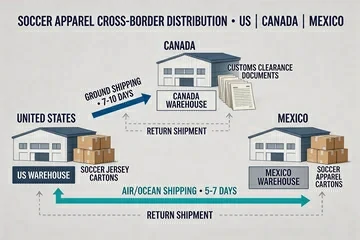
For U.S., Canada, and Mexico coverage, freight planning should be treated as part of assortment planning. Once inventory crosses borders, duties, tariffs, and taxes become part of the margin calculation rather than a back-office detail.
Cross-border shipping also introduces customs clearance, country-specific documentation, and longer transit variability. That is why we normally suggest a split model: place core inventory closer to the highest-confidence market, and reserve flexible replenishment stock for secondary demand so the distributor is not forced into urgent, low-margin moves when sales spike.
How to set reorder windows before demand compresses
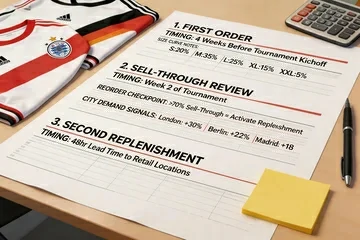
The first order should not attempt to cover the entire tournament. A better approach is to protect the opening demand window, then leave room for a controlled second wave once real sell-through data starts to replace forecast assumptions.
In practice, reorder logic should be based on size-level movement, not only on total units sold. A distributor can recover from a moderate volume miss more easily than from a broken size curve in a fast-moving city. We prefer smaller, faster follow-up decisions over one oversized opening commitment that becomes difficult to rebalance.
What suppliers should be able to support during the tournament window
A supplier for this cycle should be able to do more than make jerseys. Distributors should ask about carton planning, label consistency, mixed-size packing, and private labeling and pack-out requirements before placing bulk orders, because operational detail affects how quickly goods can move into local channels.
The same supplier should also show discipline in material consistency and outbound control. In our view, quality checks before outbound release matter as much as quoted unit price, especially when the sales window is short and there is little tolerance for relabeling, repacking, or returns once goods are already in market.
Frequently Asked Questions
Q: Should local distributors stock by country team or by host city?
A: We recommend starting with country-team demand, then adjusting by host-city channel behavior. The host city determines timing and replenishment pressure, but the country program usually determines what actually moves. In other words, the city tells you when demand may hit, while the product choice tells you whether the order will convert. That is why location planning and assortment planning should be built together.
Q: Are blank jerseys still relevant during a World Cup cycle?
A: Yes. Blank jerseys remain useful because many local buyers are not only chasing tournament fanwear. Schools, amateur clubs, event organizers, and promotional resellers still need fast-turn decorated garments. For distributors, blank programs also reduce forecasting pressure. They create a more flexible layer of demand that is less dependent on match results or a single national-team storyline.
Q: How early should a distributor place the first bulk order?
A: The first bulk order should be early enough to protect customs, inland transfer, and receiving time, but not so early that the full buy depends on assumptions made months before demand is visible. We prefer a staged approach. The opening order should cover the first selling window, while the second order should be reserved for verified size movement, city-level response, and actual channel feedback.
Q: What matters most when choosing a supplier for World Cup programs?
A: The key test is operational reliability under a short selling window. A supplier should offer stable sizing, repeatable color consistency, disciplined pack-out, and clear communication on lead times. Price still matters, but reliability protects margin. During an event cycle, a cheaper order can become more expensive if it arrives late, ships with mixed specifications, or cannot support a clean replenishment plan.
Ending
If you are planning inventory for host-city demand, now is the right time to align product mix, timing, and logistics. Use this window to discuss your bulk order requirements with our wholesale team, request a wholesale price list, or ask for samples before the tournament demand curve becomes less predictable.