
We explain how procurement teams can manage custom football shirts and sublimation jerseys from design brief to bulk delivery, covering materials, printing processes, timelines, quality control, and supplier evaluation for global wholesale projects.
Definition
What is custom football shirts sublimation jerseys wholesale? It is a bulk procurement model where clubs, brands, or retailers design fully customized football jerseys using sublimation printing, then source them at scale from specialized manufacturers.
- Covers the full process from design concept, sampling, and sublimation printing to bulk delivery
- Focus on fabric GSM, fiber composition, and color fastness performance data
- Considers MOQ, lead time, production capacity, and logistics for global markets
- Explains quality control, certifications, and compliance requirements for Europe and North America
- Compares sublimation jerseys with traditional cut-and-sew or screen-printed shirts
- Provides a practical selection framework for evaluating wholesale suppliers
From Design Brief to Production-Ready Artwork
In B2B projects, design is not just visual creativity; it is a technical specification. When we develop custom football shirts in sublimation jerseys wholesale projects, we start with a structured design brief that can be translated into production-ready artwork and pattern data.
A typical design brief for a club or retail brand includes panel layout, color standards, branding placement, player personalization rules, and compliance notes. The Argentina 26 Home Men’s Jersey (Player Version), for example, uses sky blue and white vertical stripes with a tonal gradient and gold logos. Reproducing such details in sublimation requires clear Pantone or LAB color targets, minimum line thickness, and logo resolution parameters.
For efficient communication with the factory, we recommend the following design data package: vector files in AI or EPS, separate layers for sponsor logos, numbers, and crests, color references per panel, size grading table from youth to adult, and clear notes if fit should follow authentic player version (slim fit, closer body contour) or fan version (more relaxed).
Technical Fabric Selection for Sublimation Jerseys
Sublimation printing performance is directly linked to fabric structure and fiber composition. For football shirts, we usually work with 100% polyester or high-polyester blends due to their dye affinity and moisture management capabilities. Common GSM ranges from 130 to 180 GSM; 140–150 GSM is typical for match jerseys, while 160–180 GSM is used when buyers prioritize durability over minimum weight.
A performance-oriented player version similar to the Argentina 26 Home Men’s Jersey often uses a lightweight, engineered knit with zoned ventilation. In numeric terms, moisture-wicking fabrics target a moisture management test result where drying time is reduced by 20–35% against standard polyester, and air permeability is improved by 15–25%. Procurement teams should request data sheets covering GSM, composition, knitting type (interlock, mesh, bird’s-eye), and test results for color fastness to washing and perspiration.
For Europe and North America, it is common to specify OEKO-TEX Standard 100 for fabric safety and, where recycled yarns are used, GRS certification for traceability. Asking suppliers to provide corresponding certificates and batch-level documentation helps mitigate compliance risk in downstream markets.
Sublimation Printing Process: From Paper to Fabric
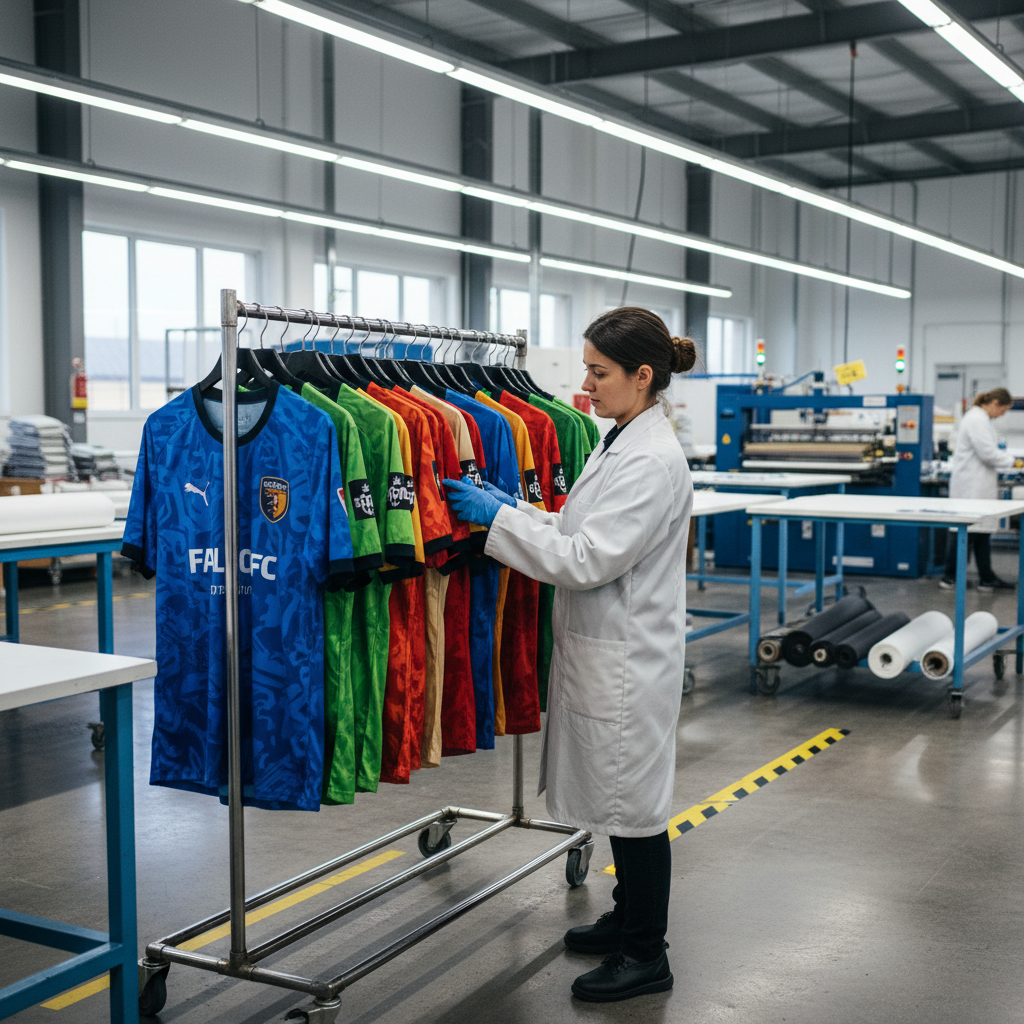
Sublimation printing transfers design from paper to polyester fabric using heat and pressure. Compared with screen printing or heat transfer vinyl, sublimation creates a fully integrated print that does not add surface weight and does not crack or peel over time. This is critical for high-mobility sports garments such as football shirts.
| Feature | Traditional printed football shirts | Sublimation football shirts |
|---|---|---|
| Printing method | Screen print or heat transfer on fabric panels | Digital sublimation print onto transfer paper then onto fabric |
| Color and pattern flexibility | Limited colors per design, complex patterns cost more | Full-color gradients, photos, and complex patterns at similar cost |
| Weight impact | Print adds surface weight and potential stiffness | Ink becomes part of fiber, almost no added weight |
| Durability of logos and numbers | May crack, peel, or fade after 30–50 washes | Typically retains color for 80–100 washes with proper inks |
| Per-unit cost structure | Higher setup cost, more economical only at large volumes per design | Flexible for small runs, efficient for multi-design bulk orders |
For wholesale orders, the key parameters we monitor are ink type, paper quality, transfer temperature, and dwell time. Typical transfer temperatures are 200–210°C with 30–45 seconds press time, but these values are adjusted based on fabric and ink system. Under-curing by just 10 seconds can reduce color depth by 5–10%, which becomes visible on large solid areas such as club stripes or sponsor blocks.
Quality control at this stage includes color deviation checks against approved lab dips, ghosting or misalignment inspection, and wash tests on pilot pieces. For brand-sensitive products such as World Cup-themed jerseys, we recommend agreed Delta E thresholds for color differences, typically within 1.0–1.5 under standard light conditions.
Pattern Cutting, Sewing, and Fit Management
Once sublimation is complete, panels move to cutting and sewing. From a procurement standpoint, this is where fit consistency and workmanship determine return rates and end-user satisfaction. Player version jerseys usually adopt a slimmer fit with shaped side panels and narrower sleeve openings. Fan or replica versions accept more ease in chest and waist for broader body types.
We recommend specifying measurement tolerances (for example, chest circumference ±1.5 cm, body length ±1.5 cm) and seam construction standards such as flatlock stitching on high-friction zones and bar-tacks at stress points. Procurement teams should also request size sets for fit validation before bulk, including at least S, L, and 2XL to cover grading extremes.
Capacity, MOQ, and Lead Time Planning
For global wholesale buyers, production capacity and flexibility often matter as much as unit price. A mid-sized sublimation factory may handle 50,000–150,000 jerseys per month, depending on machine fleet and sewing lines. In our own model, we support no MOQ on certain standard patterns, allowing test orders without volume risk, and then scale production as demand is validated.
Typical timelines are as follows: 3–7 days for artwork adjustment and digital mockups, 7–12 days for pre-production samples including shipping time, and 25–35 days for bulk production after sample approval, depending on order quantity and complexity. Peak seasons around major tournaments such as the World Cup may extend lead times by 20–30%, so early reservation of capacity is advisable. For reference on event-themed products, our dedicated World Cup range can be reviewed at World Cup jerseys wholesale.
From a logistics perspective, carton loading plans and CBM calculation influence shipping cost per jersey. For example, packing 80–100 adult jerseys per 5-ply export carton yields roughly 0.08–0.1 CBM, resulting in 10,000–12,000 jerseys per 20-foot container depending on packing method and accessories. Procurement teams can use these figures to model landed cost in key markets.
Compliance, Certifications, and Social Accountability
For Europe and North America, compliance is a mandatory part of supplier evaluation. Chemical safety is typically covered by OEKO-TEX Standard 100 or equivalent test reports; recycled materials, when used, should be backed by GRS scope and transaction certificates. For social compliance, buyers often require BSCI, SMETA, or similar audits to manage reputational and regulatory risk.
In addition to certifications, we suggest requesting factory profiles and audit summaries. A transparent supplier should be comfortable sharing information similar to what we disclose on our own corporate page at About our jersey manufacturing capabilities, including manufacturing locations, core markets, and experience with club, federation, or event-related projects.
Step-by-Step Guide: Custom Sublimation Jersey Order Flow
To align internal planning with factory workflows, procurement teams can map their project against the following step sequence from first contact to final delivery.
- Step 1: Requirement definition. Consolidate design references, target price range, delivery window, and size breakdown. Clarify whether you need player version, fan version, or both.
- Step 2: Supplier screening. Shortlist 2–3 suppliers based on technical capability, certifications, and existing football portfolio. Review their World Cup or club case studies where available.
- Step 3: Artwork and technical confirmation. Share vector files, color standards, and fit requirements. The supplier creates production-ready layouts and confirms printing and sewing details.
- Step 4: Sampling and testing. Approve physical samples for fabric hand-feel, print accuracy, and measurements. Conduct internal wash tests and, where necessary, independent lab tests.
- Step 5: Bulk production and inline quality control. After sample sign-off, the factory starts printing, cutting, and sewing. Inline inspections verify color consistency, sizing, and workmanship.
- Step 6: Final inspection, packing, and shipment. Conduct AQL-based inspections, confirm packing list and CBM, and arrange sea or air freight according to launch timelines.
Evaluating Wholesale Partners for Long-Term Projects
Beyond a single order, most clubs, federations, and retailers seek stable partners for multi-season programs. We suggest evaluating suppliers across four dimensions: product performance, delivery reliability, communication efficiency, and cost transparency. For example, tracking on-time delivery rate over at least three orders, monitoring defect rates below 1–2%, and assessing responsiveness during design changes provide an objective picture of long-term suitability.
A partner with the ability to handle both standard wholesale items and fully customized sublimation projects reduces coordination complexity. Where your planning includes major tournament cycles or kid’s kits extensions, integrated capabilities simplify execution and inventory management. Teams exploring new programs or needing technical clarification can initiate a structured discussion via Contact us for custom sublimation jersey projects.