
This tutorial explains how procurement teams can verify AQL inspection standards for wholesale football jerseys, including sampling plans, inspection levels, defect classification, data interpretation, and supplier audit practices for global orders.
Definition
What is AQL inspection for wholesale football jerseys? It is a statistical quality control method that defines the maximum acceptable defect level in a inspected sample before approving a production lot.
- AQL defines defect tolerance by percentage, not by individual pieces
- Correct sampling level and AQL values must be specified in purchase contracts
- Defects for football jerseys must be clearly classified as critical, major, minor
- Inspection reports should show sample size, defects by type, and pass/fail decision
- Independent verification includes document review, process audit, and re-inspection
- Global compliance requires alignment with buyer country quality and labeling rules
When we purchase wholesale football jerseys for global distribution, AQL inspection standards become a core control point in the supply chain. If we do not define and verify AQL correctly, defects in a few percent of goods can quickly scale into thousands of pieces, creating returns, reputational risk, and compliance problems in multiple markets.
1. Basic AQL Concepts for Wholesale Football Jerseys
AQL (Acceptable Quality Level) is a statistical indicator used with ISO 2859-1 or ANSI/ASQ Z1.4 sampling plans. Instead of checking 100% of jerseys, we inspect a defined sample size from the lot. The inspection result decides to accept or reject the entire lot. For teamwear and club licensed jerseys, even a 2% defect rate may be operationally unacceptable, especially when jerseys are tied to time-sensitive events like World Cup or continental tournaments.
In practice, many apparel buyers use combinations such as AQL 2.5 for major defects and AQL 4.0 for minor defects. For higher-risk issues (for example wrong country flag, offensive misprint, or safety-related fabric problems), we may set critical defects at AQL 0 or 0.65, effectively zero tolerance in the sample.
2. How AQL Applies Specifically to Football Jerseys
Football jerseys combine textile, printing, and branding risks. Compared with generic T-shirts, the value of one defective jersey is often higher due to licensed logos, player names, and tournament editions. For reference, a typical wholesale lot might be 3,000–10,000 pieces per style, with sizes S–XXL and multiple player variants. At 3% major defects on a 5,000-piece lot, 150 jerseys are affected, which can impact a full team order program for several clubs or retailers.
Key defect types in football jerseys that we usually classify within AQL include misaligned heat-transfer logos, incorrect pantone color for team or federation, delamination of flock or number print after minimal washing, fabric GSM deviations outside agreed tolerance, and stitching failures around neck, armholes, and hem that impact durability during intensive use.
| Feature | Traditional AQL Practice | Modern AQL Practice for Football Jerseys |
|---|---|---|
| Sampling level selection | General Level II used by default for all products | Different levels for mass jerseys vs. limited editions, with tighter levels for licensed and tournament SKUs |
| Defect classification | Generic major/minor without sport-specific criteria | Detailed matrices for logo position, color match, player name accuracy, performance seams |
| Data recording | Manual paper reports, limited traceability | Digital reports with lot ID, SKU, size ratio, defect mapping per operation |
| Compliance focus | Mainly visual quality, basic packaging check | Integrated checks for fiber content, care labels, OEKO-TEX, and export market regulations |
| Supplier involvement | AQL controlled mainly by external inspector | Supplier in-line self-inspection aligned with buyer AQL plus third-party or buyer audit |
3. Defining AQL Requirements in Purchase Documents
To verify AQL at inspection stage, we must first define it clearly in our RFQ, purchase contract, and technical specification pack. Without this, discussions with suppliers or inspection agencies become subjective. For wholesale football jerseys, we normally specify at minimum the lot definition, sampling standard, inspection level and AQL values, defect classification rules, and pass/fail decision logic.
For example, for a 5,000-piece men’s football jersey order using General Level II and AQL 2.5 major / 4.0 minor, the sample size might be 200 pieces with acceptance/rejection numbers defined by the sampling table. We then tie this specification to penalties or rework obligations if the lot is rejected.
Typical defect classification for football jerseys
Critical defects (AQL 0–0.65): wrong team, federation, or national symbols; offensive or prohibited words; use of non-compliant fabric with restricted substances; sharp accessories causing injury. Major defects (AQL 2.5): noticeable logo misplacement beyond tolerance, color mismatch visible to naked eye under D65 light, broken seams more than a defined length, strong skew in panel alignment. Minor defects (AQL 4.0): slight stitch irregularities without functional impact, minor print dots, small color variation within agreed delta E, packaging label misalignment not affecting information accuracy.
4. Step-by-Step: How to Verify AQL Inspection Standards
Verification means we do not simply receive an inspection report at face value. We cross-check the sampling plan, execution, and recorded data against our agreed AQL parameters. Below is a practical step guide we can apply consistently across suppliers and countries.
- Step 1: Confirm that the inspector used the correct lot size, sampling standard (such as ISO 2859-1), and inspection level as defined in our purchase order.
- Step 2: Verify the sample size, acceptance number, and rejection number against the official AQL table, ensuring they match the declared AQL values.
- Step 3: Check that all inspected SKUs and sizes were proportionally represented in the sample based on the actual size and player distribution in the lot.
- Step 4: Review the defect list, confirming each defect is correctly classified as critical, major, or minor according to our agreed defect matrix for football jerseys.
- Step 5: Validate that measurement checks were done for key parameters like chest width, body length, sleeve length, and fabric GSM with tolerances recorded.
- Step 6: Ensure functional tests such as print adhesion, seam strength, and colorfastness spot checks were implemented where required, especially for performance jerseys.
- Step 7: Confirm that packaging, barcode, size label, and country of origin label were inspected against our packaging manual, not only visually but also across carton samples.
- Step 8: Recalculate the total defects by category and compare with the AQL acceptance and rejection numbers to confirm the final pass/fail decision is mathematically correct.
- Step 9: Where results are borderline, request photographic evidence and, if necessary, authorize a re-inspection or additional sampling at our own or supplier’s cost.
5. Linking AQL to Material, Printing, and Certification
For football jerseys, especially polyester performance fabrics between 130–180 GSM with moisture-wicking finishes, material compliance and printing stability are as important as visual appearance. We typically request fabric and trim suppliers to provide OEKO-TEX STANDARD 100 or equivalent certificates ensuring that dyes and finishes meet human-ecological requirements for next-to-skin sportswear.
In addition to end-of-line AQL inspections, we integrate lab testing for colorfastness to washing and perspiration, print adhesion, and dimensional stability after washing. These tests are not part of classical AQL visual inspection, but they significantly reduce functional defect rates in real use. For recycled polyester jerseys, we may require GRS certification traceable to yarn level, and we align AQL acceptance with documentation checks on recycled content claims.
From a social compliance perspective, working with factories holding BSCI or equivalent audit results helps reduce the risk of forced overtime or unapproved subcontracting, both of which can affect process control and indirectly increase defect rates during high-pressure tournament seasons.
6. Supplier Capability, Capacity, and AQL Performance
AQL verification is easier when the factory has stable processes. For mass football jersey programs, we normally look for suppliers with monthly capacity above 50,000–100,000 pieces, automated cutting, and stable printing lines (sublimation, screen, or digital). Minimum order quantities (MOQ) per design and per size set directly influence how we define lots and sampling plans. For example, a supplier with MOQ 300 pieces per design per color may group multiple designs into one inspection lot; we must ensure AQL sampling still covers each design and key size.
Delivery cycles, usually 30–60 days from PP sample approval to shipment for standard jerseys, also influence our AQL strategy. When lead times are tight around major tournaments, we may accept a slightly higher minor defect tolerance but keep major and critical thresholds unchanged to ensure brand and compliance protection.
7. Practical Documentation: What to Request from Suppliers
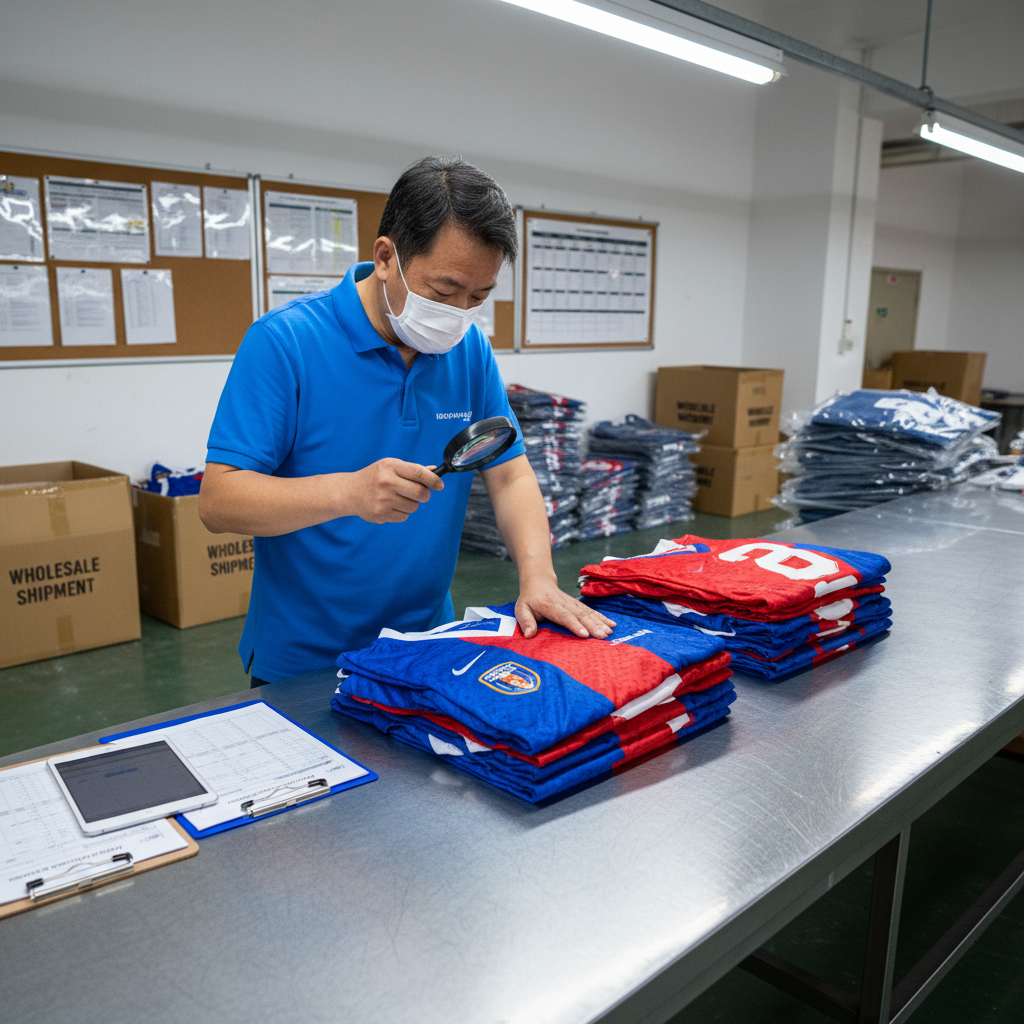
To verify AQL consistently, we standardize our documentation requirements. From factories or inspection partners, we typically request the inspection protocol with lot size, sample size, inspection level, AQL values, and acceptance decision; detailed defect list with photos, quantity, and classification; measurement and test result sheets; carton and packaging checklists including CBM calculations for logistics planning; and copies of relevant certificates such as OEKO-TEX, GRS, and valid social audits. This creates a traceable file for each shipment and allows us to compare real defect rates by supplier, product line, and season.
For projects linked to international football events, we also monitor cumulative AQL performance. For example, if a supplier’s last four inspections for jerseys show average major defect findings close to the acceptance limit, we proactively trigger process audits instead of waiting for a lot rejection. Over time, this reduces rework and air-freight costs caused by late quality issues.
8. Integrating AQL with Your Football Jersey Sourcing Strategy
AQL inspection is one component of an integrated sourcing strategy for football jerseys. When we select suppliers, we combine technical capability (fabric technology, printing precision), compliance (OEKO-TEX, GRS, BSCI), and delivery reliability with their historical AQL performance. For tournament or league programs, we often define different AQL schemes for mass fan jerseys versus limited-edition collector versions, aligning quality expectations with positioning and end-user price points.
For buyers looking to extend their product ranges with global tournament jerseys, reviewing existing product and quality frameworks from specialized suppliers can be helpful. For example, reviewing collections under categories like world tournament jerseys via platforms such as the World Cup section at World Cup football jerseys allows us to understand typical styles, print complexity, and likely inspection focus areas. Direct communication with technical teams through pages like About our football jersey capabilities and Contact our football jersey sourcing team can further refine AQL and inspection parameters for specific programs.