
This article outlines key compliance and safety requirements for youth blank soccer jerseys in bulk purchasing, covering fabric testing, chemical limits, labeling, certifications, supply chain transparency, and a stepwise compliance checklist for B2B team orders.
Definition
What is youth blank soccer jerseys compliance for team orders? It refers to ensuring bulk-produced, logo-ready youth jerseys meet safety, chemical, labeling, and quality standards in all target markets before customization or distribution.
- Youth jerseys must comply with child-specific chemical and flammability regulations
- International certifications like OEKO-TEX and GRS help verify material safety
- Clear testing protocols and batch traceability reduce compliance risk in team orders
- MOQ, lead time, and capacity should align with documented quality controls
- Labelling, tracking, and documentation must meet import and customs requirements
For youth blank soccer jerseys, procurement teams are managing two risk layers simultaneously: textile safety for children and regulatory compliance across multiple export markets. Non-compliant stock can lead to shipment delays, returns, or forced recalls, with disproportionate cost impact on large team or league orders.
Regulatory Landscape for Youth Blank Soccer Jerseys
Youth sportswear intersects with regulations for children’s products and textile imports. In our experience, multi-country team programs typically need alignment with at least three frameworks: chemical restrictions, physical safety, and labeling rules. For EU-focused teams, REACH and general product safety directives dominate. For the US, CPSIA, state-level chemical restrictions, and flammability standards are critical.
Across markets we usually see similar baselines: limits on lead and heavy metals, bans on certain azo dyes, phthalate limits for prints, and requirements for reliable fiber content and care labels. For cross-border e-commerce distribution, inconsistent labeling between language zones is one of the most common compliance gaps in youth jerseys.
Key Technical Specifications and Material Choices
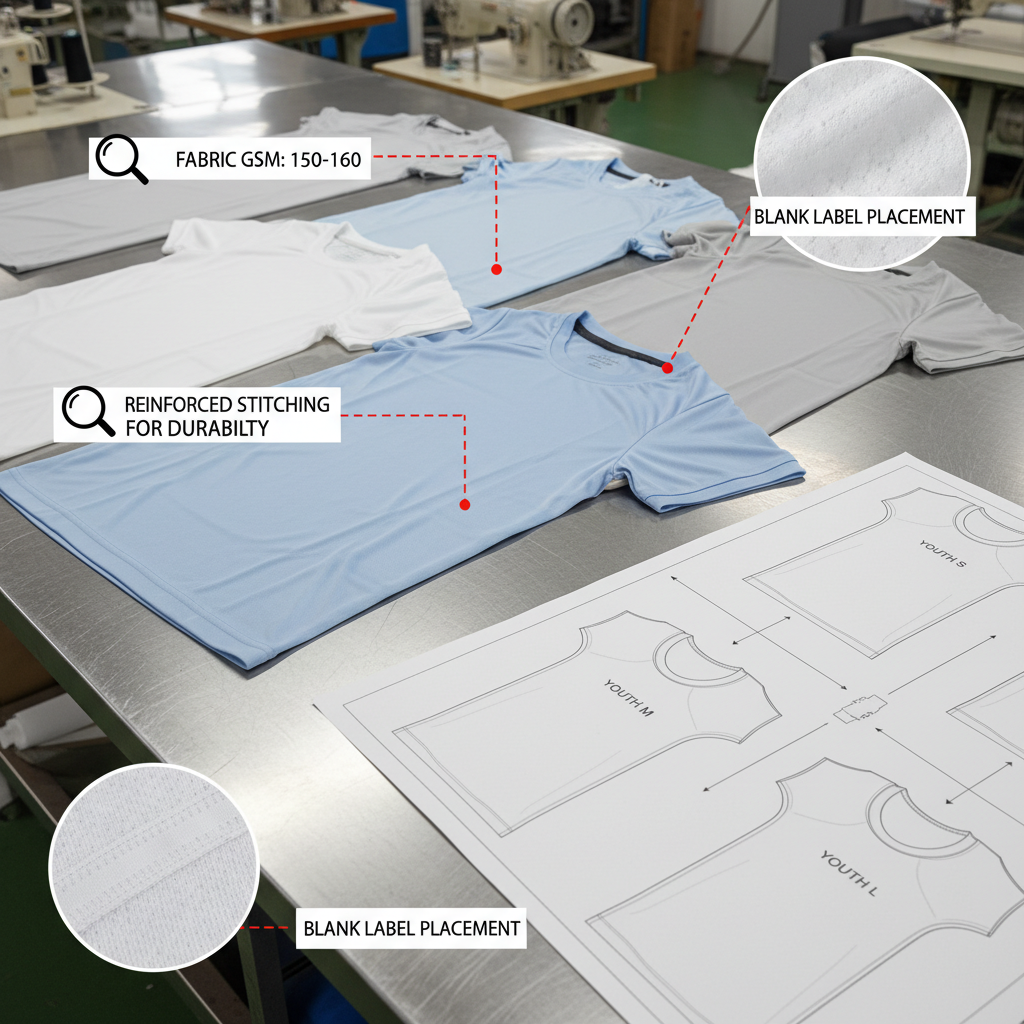
Youth blank soccer jerseys are usually specified around GSM, fiber composition, knitting structure, and finishing treatments. Typical fabrics for team-level orders are 120–170 GSM, 100% polyester interlock or mesh, sometimes with 5–8% elastane for stretch panels. From a compliance standpoint, consistency of composition is as important as the nominal spec because fiber variance affects both performance and test validity.
For moisture management, many buyers request wicking finishes or micro-mesh zones. These chemical finishes must be compatible with applicable eco-standards. We generally recommend pairing performance requirements with clear test methods, such as specifying color fastness to perspiration and washing (ISO 105 series) and dimensional stability after laundering (ISO 5077). For youth categories, we see more conservative thresholds for pilling, seam strength, and snagging because garments are often used at higher frequency.
Testing, Chemical Safety, and Certifications
For youth blank soccer jerseys, chemical safety is non-negotiable. We see most compliant supply chains working with accredited third-party labs on a defined protocol before scaling production. A typical test plan for EU and US markets combines heavy metal tests, azo dye screening, pH, formaldehyde, and phthalates on any PVC-based prints or trims. For polyester jerseys, about 70–80% of test failures we encounter are related to prints, coatings, or neck labels, not the base fabric itself.
Certifications help procurement teams reduce verification overhead. OEKO-TEX STANDARD 100, especially product class II (for products in direct skin contact), is widely used for youth jerseys. When recycled polyester is specified, Global Recycled Standard (GRS) certification provides both recycled content verification and chemical input management. For social and factory-level compliance, BSCI or equivalent audits give some assurance that working conditions and management systems are adequate for long-term programs.
| Feature | Traditional approach | Modern compliance-focused approach |
|---|---|---|
| Fabric selection | Basic polyester, limited testing | Pre-approved OEKO-TEX certified fabrics with full test history |
| Chemical control | Single-region basic screening | Unified global RSL aligned with EU REACH and CPSIA |
| Documentation | COC only on request | Standard package: test reports, declarations, and batch traceability |
| Recycled content | Unverified marketing claims | GRS-certified recycled yarns with transaction certificates |
| Social compliance | Informal factory checks | Formal BSCI or equivalent audit cycles and CAP tracking |
Labeling, Traceability, and Supply Chain Transparency
For youth categories, traceability is increasingly a prerequisite. Teams and schools want to know where jerseys are made, under which standards, and how issues are managed. At minimum we recommend capturing factory name and address, production line, batch or lot number, and production date range for each order. This information should be linked to the corresponding test reports so that any future inquiry can be closed within days rather than weeks.
Country of origin, fiber content, care instructions, and size must meet each destination market’s labeling rules. For multi-language jerseys, dual-language care labels are common; inconsistency here is a frequent customs issue. In our own operations we associate each size run to a defined CBM per carton and a packing list that allows trace-backs from pallet level to sewing line. This also streamlines repeat orders of the same youth blank soccer jerseys across seasons.
MOQ, Capacity, and Lead Times Under Compliance Constraints
Compliance inevitably interacts with MOQ and delivery cycles. For youth team jerseys, the main cost drivers are fabric minimums from certified mills, lab testing fees, and changeover times on sublimation or screen lines. As a reference, many compliant suppliers structure MOQs around fabric color and style, for example 300–500 pieces per colorway, with 4–6 size breaks for youth grading.
For new programs requiring full testing, we often see development lead times of 25–35 days, including lab tests. Once a style is approved and test reports are in place, bulk lead times of 30–45 days are typical for 1,000–5,000 piece team orders, depending on decoration complexity. High-volume capacity above 10,000 units per month usually requires reserved production windows and firm forecasts, which should be framed in supply agreements along with re-testing triggers, such as yarn change or new chemical supplier.
Step-by-Step Guide: Building a Compliant Team Order
To control risk and cost, we recommend a structured workflow for youth blank soccer jersey procurement. The following steps reflect how many experienced buyers now sequence their orders, from initial specification through shipment release.
- Step 1: Define technical specifications including GSM, fabric composition, size range, and performance requirements, and align them with your internal restricted substances list.
- 步骤 2: Shortlist suppliers able to provide OEKO-TEX, GRS, and valid social audits, and verify their recent lab reports against your target markets.
- Step 3: Request development samples of youth blank jerseys, including color lab dips and size sets, and conduct fit and comfort evaluation with representative players.
- Step 4: Confirm testing protocol with an accredited lab, covering base fabric, prints, and labels, and assign responsibility for testing costs and re-tests.
- Step 5: Lock final tech pack, labeling layout, and packing specifications, including carton CBM and barcoding, before issuing purchase orders.
- Step 6: Implement in-line and final inspections with clear AQL levels, linking each batch to lab test reports and ensuring documentation is complete before shipment.
- Step 7: Post-season, review claims, returns, and performance data, then adjust specs, suppliers, or test frequency accordingly for the next cycle.
Integrating Customization and Tournament Requirements
Many youth teams use blank jerseys as a base for names, numbers, league badges, and sponsor marks. These post-processes add new chemical inputs and must be considered in compliance plans. Heat transfer films, screen inks, and sublimation papers should meet the same RSL as the base garment. Color fastness and migration between print and base fabric are critical when jerseys are used in high-temperature or high-humidity environments.
For teams participating in major tournaments, additional regulations may apply for numbering, logo placement, and visibility. While competition rules typically address aesthetics rather than safety, any added trims or patches must not introduce small parts risks or sharp edges in youth sizes. For buyers also sourcing tournament-related products, reviewing category structures such as the World Cup ranges can help rationalize specifications across age groups and genders. For reference, you can review our tournament-focused categories at World Cup soccer jerseys category to understand how competition requirements influence jersey structure.
Supplier Evaluation and Ongoing Governance
Selecting a supplier for youth blank soccer jerseys is not only a price negotiation. We find that long-term programs are usually supported by partners who can demonstrate stable management systems, transparent capacity planning, and documented escalation procedures. Factory audits, whether BSCI or equivalent, should confirm that management can maintain consistent quality and keep records for at least three to five years, depending on your internal policy.
Procurement teams should review supplier documentation annually: updated certifications, recent lab tests, and any process changes. When evaluating a new partner, we recommend requesting sample documentation packs, including tech packs, test reports, and packing lists from recent youth or teamwear orders. This often reveals the maturity of their compliance management. Our own profile, processes, and positioning in the teamwear segment are available for review at About our soccer jersey manufacturing capabilities.
For procurement teams ready to move from evaluation to detailed discussion, aligning requirements early significantly shortens the sampling and testing cycle. Providing clear forecasts, age brackets, and target markets allows both sides to design a test-efficient program rather than repeating lab work for every small change. To discuss a specific youth team project or multi-club rollout, you can contact our technical and sales teams directly via Contact us for youth soccer jersey team orders.