
This guide helps B2B procurement teams specify soccer uniform kits with the right packaging formats, sizing standards, and logistics models to control damage rates, improve fit accuracy, and achieve predictable, fast delivery in global supply chains.
Definition
What is a B2B soccer uniform kit guide? It is a practical framework that helps procurement teams define packaging, sizing, and logistics specifications for bulk soccer kits to improve fit accuracy, reduce damage, and shorten delivery cycles.
- Clarify packaging standards that protect kits and optimize CBM and handling costs
- Use data-driven size curves and grade rules to minimize stockouts and dead sizes
- Align carton specs, labeling, and bundle units with warehouse operations
- Define lead time models, buffer stock, and shipping modes for fast delivery
- Integrate compliance, quality checks, and packaging tests into purchasing
- Coordinate graphics, printing, and SKU coding for club, national, and kids lines
Packaging Standards for Soccer Uniform Kits
For B2B soccer uniform procurement, packaging is not only a visual issue but a cost and risk parameter. It impacts CBM, breakage, humidity exposure, and warehouse productivity. We recommend specifying packaging at three levels: individual unit, inner pack, and export carton.
Individual Unit Packaging
Most soccer jerseys, including player version items such as the Argentina 26 Home Men’s Jersey, are packed in polybags for unit protection. Industrial buyers typically specify non-branded or simple branded bags, 30–50 micron thickness, with a size sticker and barcode. For moisture-sensitive markets, we see desiccant usage in 20–30 percent of orders, especially for sea freight lanes above 25 days transit.
Standard requirements we often see from North American and European buyers include polybags meeting REACH and California Proposition 65, clear suffocation warnings in target languages, and recyclability where local regulations emphasize plastic reduction. When needed, we can align unit packaging specs with retailer or distributor guidelines at no MOQ across style runs.
Inner Pack and Export Carton Configuration
Inner packs are typically bundles of 5–10 units by size or mixed sizes for direct-to-store allocation. For soccer kits, a common configuration is 10 units per size per inner pack for adult jerseys and 20 units per size per pack for kids’ kits, because kids’ garments are smaller and lighter. Export cartons then combine 4–10 inner packs depending on GSM, fabric bulk, and print application.
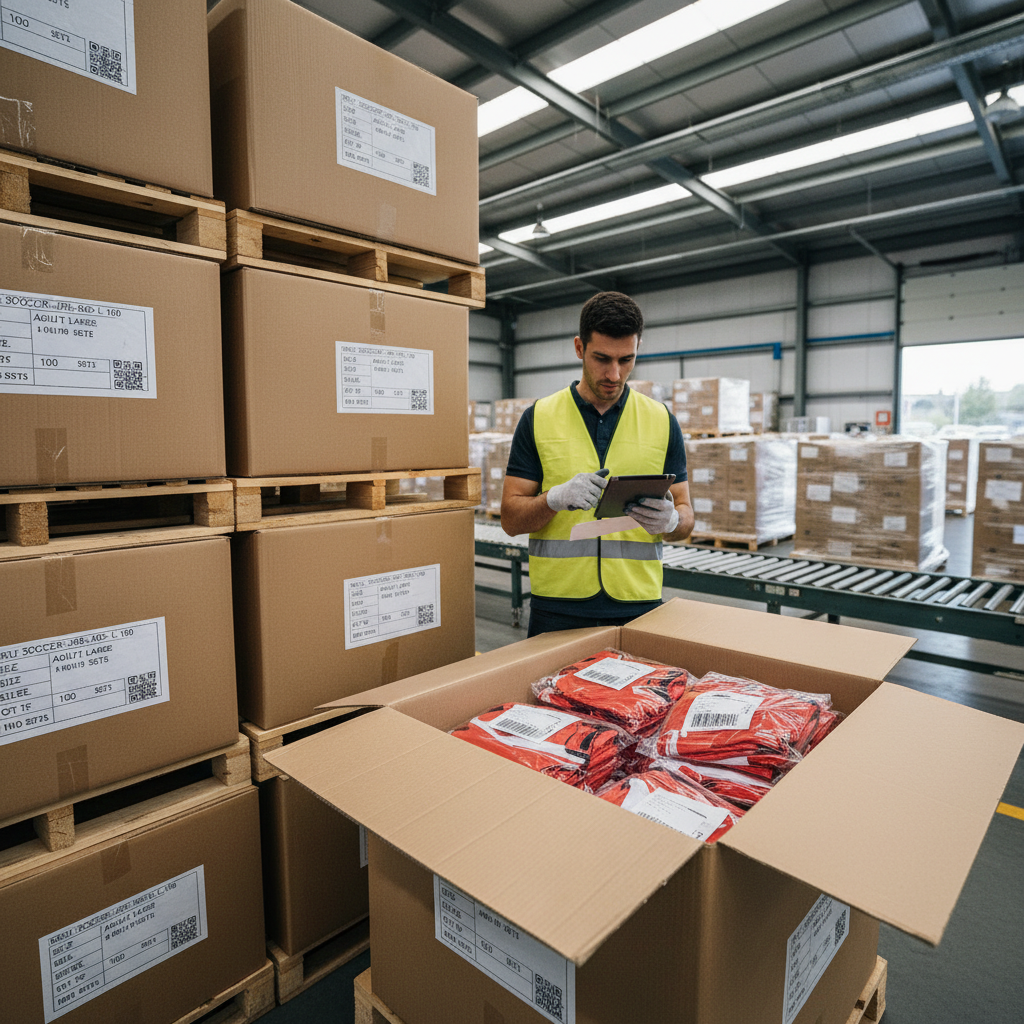
For global shipping, carton external dimensions are often optimized around pallet sizes: 60 × 40 × 40 cm or 60 × 50 × 40 cm to fit standard 1,000 × 1,200 mm and 800 × 1,200 mm pallets. Typical gross weight targets are 12–18 kg per carton to balance freight efficiency and manual handling limits. We provide packing lists by SKU, size, and quantity that integrate easily into warehouse management systems.
Labeling, Barcodes, and Compliance
For B2B buyers supplying multiple distribution channels, carton and unit labeling must be standardized. We normally apply carton labels with style code, color, size range, quantity, PO number, and country of origin. Buyers increasingly require GS1 standards for barcodes and clear indication of fiber content and care instructions complying with EU, US, and local requirements.
Our production base follows international social and environmental expectations. While soccer jerseys are not within OEKO-TEX Class I for infants, we align fabric sourcing and dyeing with mainstream standards and can discuss specific certifications on request. For procurement teams evaluating risk and compliance, we share supplier profiles and factory information through our company background resources on the About us page.
Sizing Systems and Size Curve Planning
Sizing is a central risk area for soccer uniform kits. Poorly planned size curves create dead stock and stockouts. We work with buyers across Europe and North America, where size expectations differ by region and channel. We recommend treating fit, grading, and size curves as technical parameters, not only marketing choices.
Adult and Kids Sizing Framework
For adult jerseys, standard ranges are S–2XL or XS–3XL, depending on league and fan demographics. Player version jerseys such as Argentina 26 Home Men’s Jersey typically use a slim, athletic fit. In North America, buyers often request a slightly more generous chest tolerance, while in parts of Europe the demand is closer to authentic match fit. For kids’ kits, ranges usually run from 4–14 years with 2-year grading steps.
Across a typical 1,000-unit adult jersey order, we often see size distribution patterns like 5 percent XS, 20 percent S, 30 percent M, 25 percent L, 15 percent XL, and 5 percent 2XL. Adjustments are made based on previous seasons’ sell-through data and whether the product targets club shops, mass retail, or online channels.
Grade Rules and Fit Consistency
Grade rules, typically between 4–6 cm per size step in chest circumference for adults, must be documented and locked before bulk production. For performance jerseys using lightweight, moisture-wicking fabrics in the 130–170 GSM range, we align pattern development with stretch and recovery data to avoid tightness in high-stress zones such as shoulders and underarms.
We recommend that buyers request at least one full size set in pre-production samples, including kids’ sizes when ordering kids’ kits, to verify grade rules across body types. This reduces return rates and fit-related claims in the field.
Fast Delivery Models and Supply Chain Parameters
Fast delivery for soccer uniform kits depends on coordinating design lock, fabric booking, production capacity, and shipping modes. For recurring items like popular clubs or national team colors, we can pre-position raw materials and blank jerseys, then finalize embellishment and badges after receiving purchase orders.
As a reference, a typical bulk lead time for new soccer jerseys ranges from 30–45 days after sample approval, depending on print complexity, embroidery, and badge application. For repeat orders with no design changes, lead times can be reduced by 20–30 percent. Air freight transit from production base to key North American or European hubs is approximately 5–10 days, while sea freight ranges from 25–40 days depending on route.
From a procurement perspective, we suggest defining three delivery models: regular seasonal orders, in-season replenishment, and urgent top-up orders around events such as the World Cup or major finals. For urgent requirements, we can prioritize styles like Argentina 26 Home in pre-planned capacity slots and ship partials by air to meet time-critical events, then complete the balance by sea to optimize cost.
Comparison: Traditional vs Modern Approaches
| Feature | Traditional | Modern |
|---|---|---|
| Packaging design | Generic polybags and cartons without optimization of size or CBM | Dimension-optimized cartons, standardized inner packs, and labeling aligned to WMS |
| Size planning | Intuitive size curves based on past habits and limited data | Data-driven curves using regional sales history and channel-specific profiles |
| Lead time model | One fixed bulk lead time and single-mode sea freight | Segmented lead times for seasonal, replenishment, and urgent orders with mixed air and sea |
| Quality and compliance | Reactive checks after production and simple carton inspection | Integrated fabric, print, and packaging checks with documented test results |
| Supplier collaboration | Transaction-focused, with limited visibility into capacity and materials | Joint planning of raw material booking, capacity windows, and buffer stock |
Step Guide for B2B Soccer Kit Procurement
The following sequence helps procurement teams standardize decisions around packaging, sizing, and delivery when sourcing soccer uniform kits for global markets.
- Step 1: Define target markets, channels, and expected volume by product line, including adults, kids’ kits, and event-specific collections such as World Cup or popular club jerseys.
- Step 2: Agree technical fabric and construction parameters, including GSM range, moisture-wicking performance, badge type, and printing methods for each product segment.
- Step 3: Standardize packaging specifications at unit, inner pack, and carton level, including dimensions, gross weight limits, labeling layout, and barcode standards.
- Step 4: Establish sizing standards, grade rules, and initial size curves for each market, then validate with full fit samples and adjust distributions according to prior sales data.
- Step 5: Define lead time brackets for seasonal orders, replenishment, and urgent drops, with associated shipping modes and cost implications clearly documented.
- Step 6: Align quality and compliance checkpoints, including fabric testing, print durability checks, packaging drop tests, and any required regional regulatory labeling.
- Step 7: Formalize communication, PO schedules, and forecast sharing with the supplier, ensuring visibility of capacity and buffer stock for peak demand periods.
Frequently Asked Questions
For buyers requiring more detail on our company background, factory capabilities, and experience with club and national team jerseys, we suggest reviewing the corporate information available on the About us page before specification discussions.