
This article outlines how procurement teams can specify, evaluate, and control padding and fabric quality when ordering blank goalkeeper jerseys in bulk, covering key technical parameters, test methods, compliance, and supplier management practices.
Definition
What is ordering blank goalkeeper jerseys in bulk? It is the process where clubs, distributors, and brands procure undecorated, padded goalkeeper tops at scale, with controlled fabric and padding specifications for later customization.
- Padding thickness, density and placement directly affect impact protection and comfort
- Fabric GSM, fiber blend and knit structure determine weight, durability and moisture management
- Lab testing (Martindale, color fastness, breathability) should be built into QC plans
- Certifications such as OEKO-TEX Standard 100 and GRS support compliance requirements
- Clear MOQ, capacity and lead times are essential for multi-season procurement planning
When we source blank goalkeeper jerseys in bulk, padding and fabric quality become primary risk points. Unlike outfield shirts, goalkeeper tops carry higher expectations around impact protection, abrasion resistance and sweat management. These requirements must be converted into measurable specifications and backed with transparent test data, otherwise clubs and distributors may face high return rates, player complaints, or non-compliance with internal safety standards.
Key Fabric Specifications for Blank Goalkeeper Jerseys
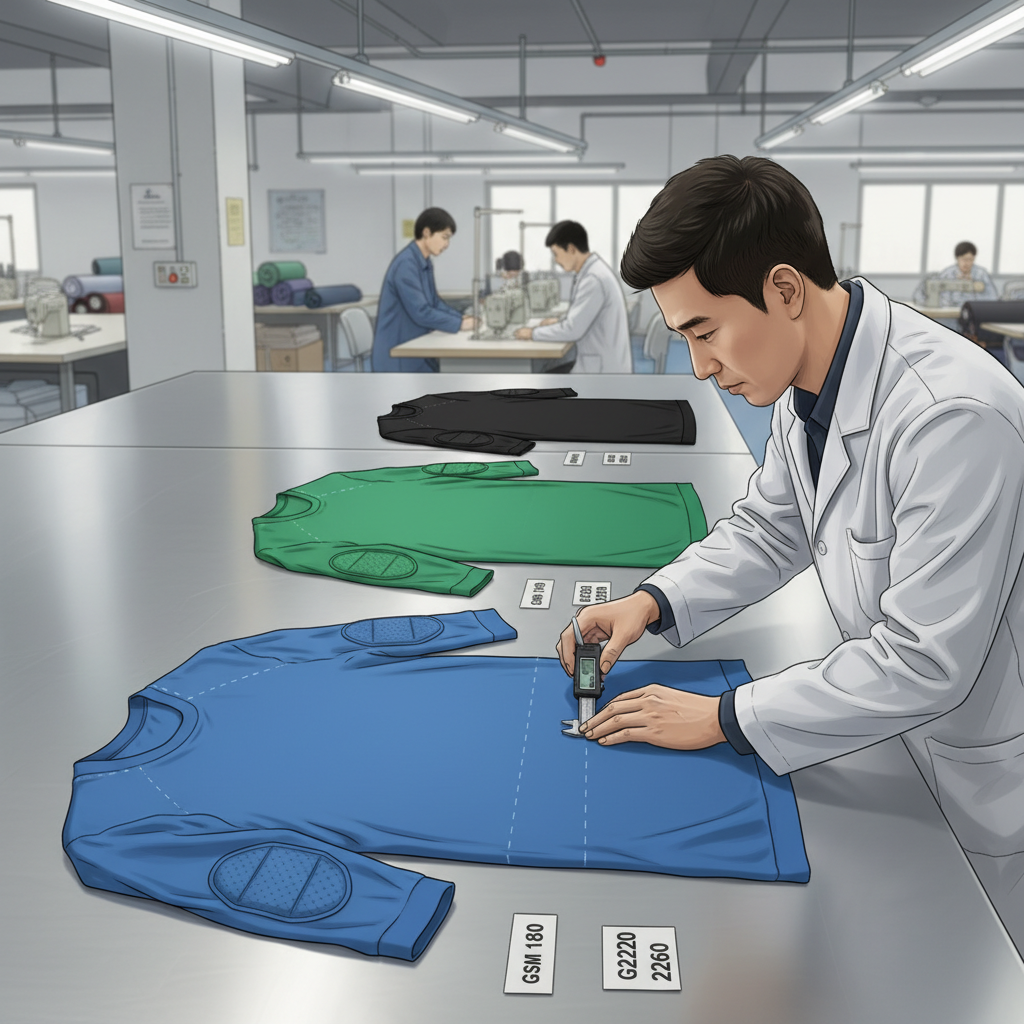
From a procurement perspective, we need to look at goalkeeper jersey fabric as a technical textile, not a fashion fabric. The specification sheet should at minimum define GSM, fiber composition, knit type, moisture management performance, color fastness, shrinkage and pilling resistance.
GSM, fiber composition and knit structure
For professional and semi-professional usage, goalkeeper jersey body fabrics typically fall between 140–200 GSM. Below 140 GSM, fabric may feel light but tends to show pad outlines and wear faster at elbows. Above 200 GSM, thermal burden increases, especially in warm climates. A common configuration is 150–180 GSM warp-knit or circular-knit polyester with 6–12% elastane for flexibility. Recycled polyester content of 30–70% is increasingly requested to support sustainability programs, which should be verified through GRS-certified yarn suppliers.
Knit structure directly affects durability and snag resistance. Interlock or double-knit constructions provide better dimensional stability and opacity than single jersey knits. Mesh panels in underarm or side zones often use lower GSM (120–150 GSM) for ventilation while maintaining the same color and dye lot. Procurement teams should require detailed fabric construction descriptions and, where possible, fabric swatches for approval before confirming bulk orders.
Moisture management and comfort
Goalkeepers experience intermittent high-intensity movements mixed with static periods, so moisture management is critical. Wicking performance can be evaluated using standards such as AATCC 197 (vertical wicking) or in-house tests comparing drying time between fabrics. In practice, many buyers specify that moisture-wicking polyester should dry at least 20–30% faster than a cotton control under identical test conditions. Including a requirement for air permeability testing, such as EN ISO 9237, helps quantify breathability, particularly important when padding covers large areas.
We also need to balance mechanical performance with comfort. Too stiff a fabric combined with high-density pads can restrict arm movement and reduce catching efficiency. Requiring minimum stretch of 20–25% in both warp and weft directions, measured by strip elongation tests, usually ensures adequate mobility.
Padding Design, Safety and Durability
Padding is the functional core of a goalkeeper jersey. We mainly see three material types: EVA foam, polyurethane foam, and more advanced viscoelastic or honeycomb structures. Each has trade-offs in impact attenuation, weight, durability and cost. Our role as buyers is to translate performance expectations into testable parameters, not only to specify foam type by name.
Padding thickness, density and placement
For training-level jerseys, elbow and forearm padding of 6–8 mm EVA foam with density around 60–80 kg/m³ is common. Match-level garments may use 8–10 mm multi-layer foam systems to improve impact absorption while maintaining flexibility. If the target leagues involve frequent artificial turf usage, higher-density foams help resist compression set and abrasion. Procurement teams should define: minimum plus-minus tolerance for pad thickness (for example ±0.5 mm), minimum foam density range, and pad coverage area in cm² for elbows, shoulders or hips as required.
Placement accuracy also matters. A misalignment of even 2–3 cm can shift padding away from the impact zones on the elbow. We recommend including a dimensional tolerance on pad positioning relative to key pattern points, and verifying this during pre-production sample approval.
Abrasion resistance and compression set
Elbow zones experience sliding and landing forces. Abrasion resistance should be evaluated both on surface fabric and on foam. Many buyers require Martindale abrasion tests (for example 20,000 cycles, ISO 12947) on elbow panels. For foam longevity, compression set tests indicate how much thickness is lost after repeated loading. A typical requirement is compression set less than 10–15% after a defined cycle count. Without these metrics, padding that initially feels protective can quickly flatten during a season, leading to increased injury risk.
Some brands are exploring more advanced impact materials. For context on protective sportswear design and impact biomechanics, we can refer to research on sports protective equipment such as studies indexed on Google Scholar, for example via the query "goalkeeper protection foam impact" on repositories like Semantic Scholar and arXiv.
Quality Control and Testing Framework
A robust quality control framework combines fabric testing, garment testing and process audits. For bulk orders of blank goalkeeper jerseys, we usually build a three-layer control system: incoming material checks, in-line process control, and final random inspection linked to AQL standards.
Fabric and color fastness testing
Color stability is critical because many buyers will later apply club crests, sponsor logos and numbers by heat transfer or screen printing. If dye crocking or migration occurs, it can damage branding elements. Color fastness to washing, perspiration and rubbing should be evaluated according to ISO or AATCC methods. Typical targets are grade 4 or higher for color change and staining on a 1–5 scale. For high-level reference on color fastness methods, see educational material from textile testing laboratories and standardization bodies.
Shrinkage after washing is another risk. For teamwear, we usually specify maximum dimensional change of ±3% after three domestic wash cycles at 30–40°C. This is particularly important for slim-fit goalkeeper jerseys where minor shrinkage can restrict arm movement and increase seam stress around pads.
Garment construction, seams and pad attachment
The way pads are integrated into the garment strongly affects durability. Common methods include stitched pad pockets, quilted channels, or direct lamination. Each method requires different process controls. For stitched pockets, seam strength at elbows should meet a minimum requirement, for example 150–200 N in seam strength tests (ISO 13935-2). For laminated pads, bond strength requirements and hydrolysis resistance tests should be defined.
Third-party inspection can help verify that padding and fabric specifications are consistently met. Structured quality manuals that link test methods to each parameter provide clarity for factories and inspectors. For instance, a manual may state: GSM ±5%, tested by ISO 3801; Martindale abrasion 20,000 cycles, no hole; seam strength minimum 150 N, tested by ISO 13935-2.
Certification, Compliance and Sustainability
Many clubs and distributors now require evidence that fabrics and foams are safe for skin contact and produced under acceptable labor conditions. OEKO-TEX Standard 100 certification can confirm that textiles meet limits for harmful substances. For suppliers using recycled polyester, Global Recycled Standard (GRS) certification provides traceability and content claims verification along the supply chain. For social compliance, BSCI or SEDEX audits are commonly requested.
Procurement teams should request certificate copies, verify validity dates, and check scope (for example, fabric mill versus garment factory). It is not sufficient to rely on general statements in marketing materials. OEKO-TEX, for example, maintains a public certificate database, which allows independent verification of certificate numbers and product classes.
Supply Chain: Capacity, MOQ and Lead Time Planning
When ordering blank goalkeeper jerseys bulk, we must align technical requirements with realistic production capabilities. Padding integration and multi-panel patterns require more complex sewing operations than standard outfield jerseys, which affects line efficiency and capacity.
Typical MOQs vary by factory type. For example, vertically integrated sportswear manufacturers may set MOQs at 500–1000 pieces per colorway, while smaller cut-and-sew workshops might accept 200–300 pieces but with longer lead times. Lead time for first orders usually ranges from 45–75 days, including pattern development, pad tooling (if using custom shapes), and bulk fabric dyeing. Repeat orders can often be delivered within 30–45 days if fabric and foam are held in greige or raw stock.
For global distribution, carton size and CBM per size run should be calculated early for freight optimization. Padded jerseys occupy more volume than flat tees. In our experience, bulk shipments of padded goalkeeper jerseys can consume 10–25% more CBM compared to similar GSM outfield tops, due to pad thickness and more generous pattern blocks.
| Feature | Traditional Goalkeeper Jerseys | Modern Goalkeeper Jerseys |
|---|---|---|
| Fabric weight and composition | Heavier 190–220 GSM polyester, low stretch, limited recycled content | 150–180 GSM high-stretch polyester or recycled polyester blends |
| Padding material | Single-layer EVA foam, 6–8 mm, basic density control | Multi-layer foams, honeycomb or viscoelastic systems with tuned density |
| Moisture management | Basic knit, limited wicking treatments | Engineered wicking finishes, mesh zones and higher air permeability |
| Testing and standards | Informal wear tests, minimal lab verification | Defined specs with Martindale, color fastness, compression set testing |
| Sustainability and compliance | Limited transparency on chemical and social compliance | OEKO-TEX, GRS and BSCI-based supplier qualifications |
Step-by-Step Guide to Ordering Blank Goalkeeper Jerseys in Bulk
- Define performance levels and usage scenarios, such as professional match play, academy training or amateur leagues, and translate them into target specs for GSM, padding thickness and durability.
- Pre-select 2–3 capable factories with sportswear experience, request detailed tech packs, existing lab reports and certification copies for fabrics, foams and sewing facilities.
- Develop and approve counter samples, checking pad placement, fit, stretch, fabric weight, finishing compatibility for printing, and conducting initial wash and wear trials if timelines allow.
- Lock final specifications, including tolerances for GSM, pad density and positioning, seam strength, color fastness, and compression set benchmarks, then incorporate them in the purchase order.
- Agree on QC and testing plans, setting AQL levels, third-party inspection points, and responsibilities for lab testing costs and failure handling before production starts.
- Plan production, shipping windows and replenishment, taking into account MOQs, production capacity, CBM impact of padding, and potential need for size or colorway consolidation.
Further Reading on Fabric Testing and Sportswear Safety
Procurement teams that want to deepen their understanding of textile performance and safety in sportswear can refer to independent resources. For an overview of moisture management in performance textiles, see the review articles indexed on scholarly platforms such as Semantic Scholar, for example via the query "moisture management sportswear". On protective equipment and impact attenuation, sports engineering research provides useful context on how padding materials behave under dynamic loads.
For official information on harmful substances regulation in textiles, including limit values used by voluntary schemes, the OEKO-TEX association provides public-facing explanations of its Standard 100 criteria. In addition, industry reporting on sustainable teamwear trends and recycled polyester adoption can help buyers align goalkeeper jersey programs with wider corporate sustainability goals.
Example external references include: technical documents and FAQs on OEKO-TEX certifications, sportswear technology reporting in international sports business media, and academic databases aggregating research on performance fabrics and impact protection.
Frequently Asked Questions
External reference: For an overview of textile moisture management research, see Semantic Scholar search results on performance sportswear, for example via the query "moisture management sportswear" on the Semantic Scholar platform.
External reference: For published discussions on sports protective equipment materials, refer to sports engineering articles indexed with queries such as "impact attenuation sports protective equipment" on Google Scholar.
External reference: For detailed information on textile harmful substance limits and certification logic, review the OEKO-TEX Standard 100 explanation and criteria updates on the official OEKO-TEX website.