
From Concept to Reality: How Factories Execute Complex Soccer Jersey Design Requirements
Overview
Complex soccer jersey development depends on more than artwork. Buyers need clear decisions on fabric behavior, pattern engineering, numbering, labels, inspection standards, and reorder planning before bulk production starts. This article explains how factories convert a design brief into a repeatable program for USA and Europe.
The design brief must become a production spec
A factory cannot execute a concept from a mood board alone. For buyers, the real starting point is a spec package that defines panel layout, color standards, badge method, number placement, size range, and packaging intent. That is where soccer jersey design stops being visual and starts becoming operational.
For national-team-inspired launches, the safest starting point is a proven base from our national team jersey programs, then adjust trim, badge application, and packaging around the target market.
Fabric and print method have to be approved together
Fabric choice should not be separated from decoration planning. When artwork, numbering, and retail presentation all need alignment, custom sublimation and trim development should be reviewed together rather than as separate approvals.
This matters because the same graphic behaves differently on mesh, interlock, jacquard, or stretch panels. Buyers should judge color depth, show-through, seam distortion, and wash stability before they approve a final visual direction.
Pattern engineering protects the graphic after sewing
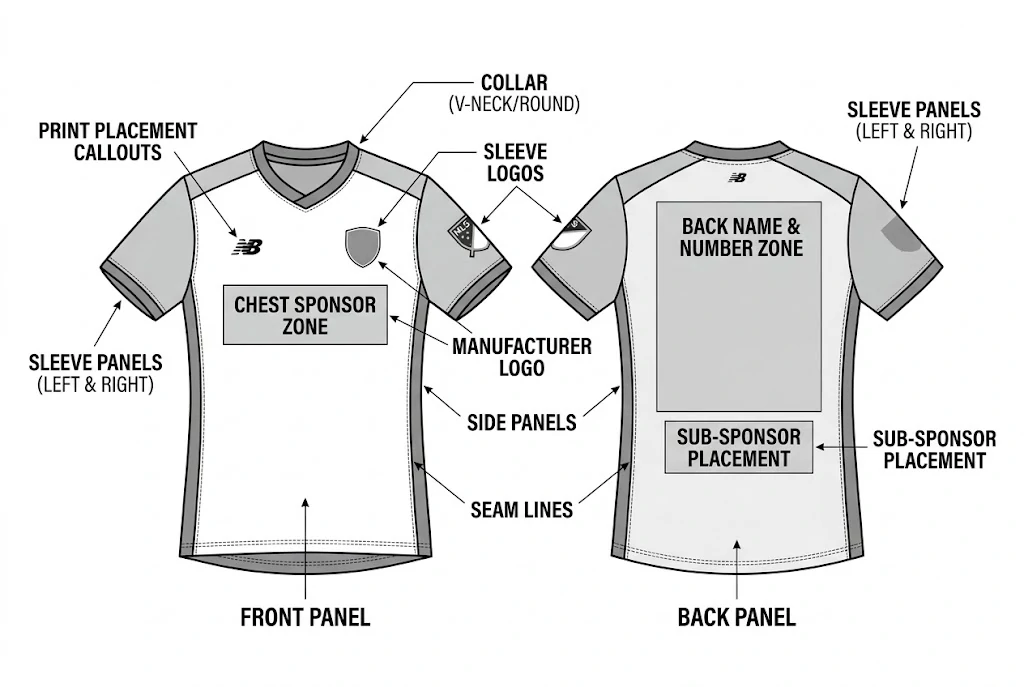
Complex jersey graphics often fail at the sewing stage rather than the design stage. Side panels, shoulder inserts, collar shapes, and sleeve curves can break stripes, gradients, and geometric blocks unless the pattern is built around the artwork from the start.
Fit engineering also affects commercial results. A player-fit body, a fan-fit body, and a kids size set cannot always share the same placement logic, so factories need separate grading and positioning rules if consistency matters across the range.
Decoration control is part of design execution
Complex programs can also require bespoke number and font typefaces, which means the decoration file set must be approved alongside the base jersey artwork.
Once artwork, trims, and labels are frozen, buyers should convert the tech pack into garment inspection procedures that cover measurements, logo placement, color tolerance, and packaging checks. Buyers also need fabric approval and AQL inspection control in writing, because color tolerance, logo position, and carton marking errors usually appear after design approval, not before.
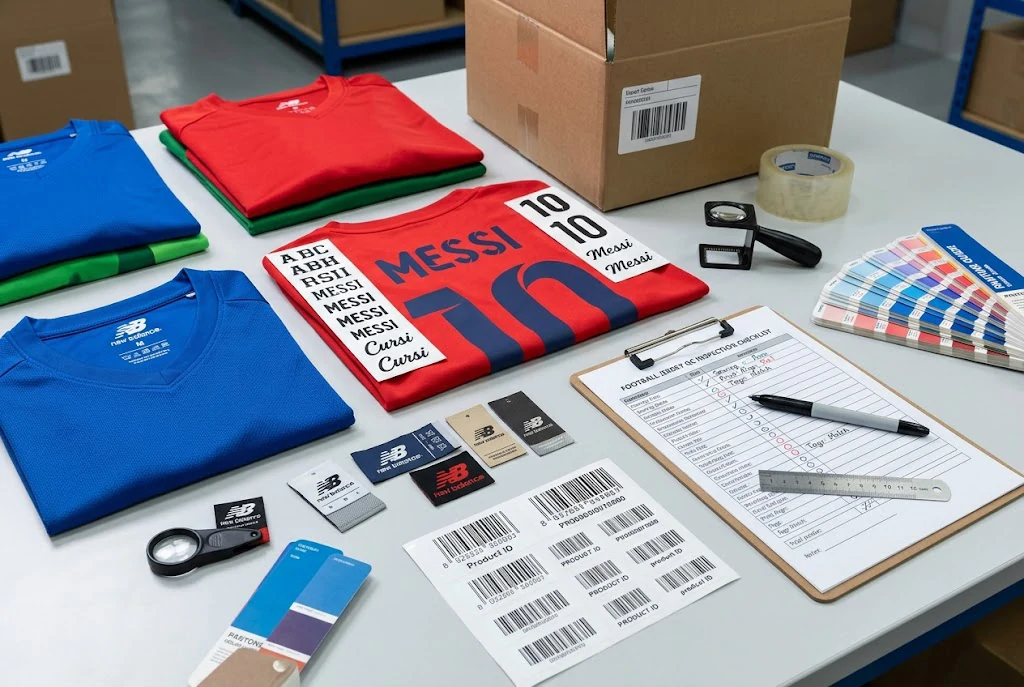
Bulk execution matters as much as sampling
A complex design is commercially healthy only when the factory can repeat it at bulk speed. Buyers should review lead time by process step, especially where custom collars, woven labels, silicone badges, or mixed decoration methods create bottlenecks.
The program is only stable when the first bulk run and the repeat order can both hit the same look. For wholesale, marketplace, and white-label fulfillment, packaging spec and barcode logic should be approved at the same time as the garment, not after.
Frequently Asked Questions
Q: What should buyers include in the first design package?
A:The first package should include front and back artwork, Pantone references, logo application method, number placement, size chart, label copy, and packaging requirements. A visual mockup is useful, but it is not enough for costing or sampling. Buyers should also state the destination market, sales channel, and target price level. Those three points affect fabric choice, decoration method, compliance labeling, and carton setup before sampling begins.
Q: Why can an approved sample still fail in bulk production?
A: Approved samples are usually made under controlled conditions, often with one fabric lot, one operator, and extra handling time. Bulk orders introduce normal variation in dye lots, heat application, stitching rhythm, and trim supply, which is where hidden risks appear. That is why we treat pre-production approval as a checkpoint, not a finish line. A size set sample, tolerance sheet, decoration map, and inspection checklist are what make the approved sample repeatable in bulk.
Q: When does a complex jersey design become inefficient for procurement?
A: A design becomes inefficient when too many elements are custom at the same time while order volume remains low. Custom collars, multiple badge methods, unique fonts, special packaging, and small replenishment runs can push cost and lead time out of proportion. In most cases, the better approach is to standardize the body and fit, then place customization on surfaces that are easier to repeat. That keeps the program distinctive without making reorders slow or inconsistent.
Ending
If you are comparing suppliers for a custom program, we can review your artwork, trim list, and target quantity before sampling begins. Request a wholesale price list, ask for samples, or discuss your bulk order requirements with our team to move from concept approval to a reliable production plan.